Speaking with Clarity: The Refined Gentleman's Approach to Expressing Desires and Boundaries in Companion Encounters
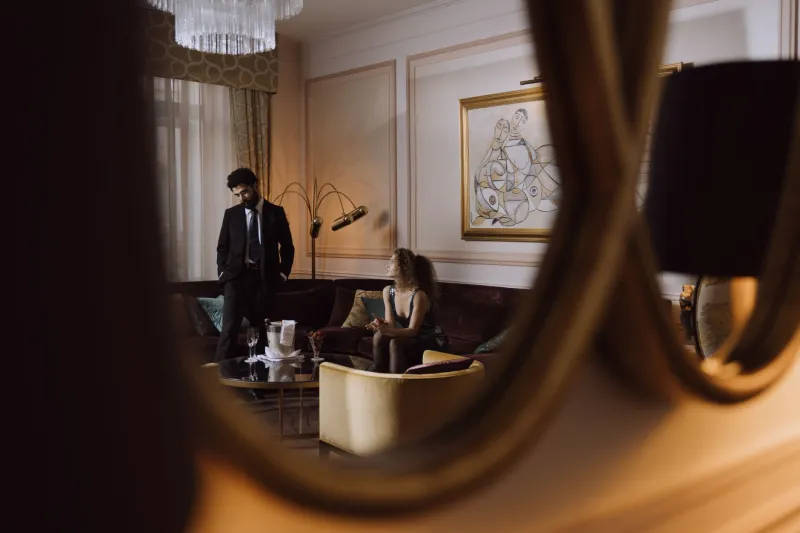
There is a particular kind of discomfort that arises when two people spend an evening together operating from different assumptions. It is not dramatic — it rarely announces itself with any obvious disruption. It lives instead in the slight misalignment of expectations, in the moment when an evening moves in a direction that neither party fully intended, or when a preference left unspoken produces an outcome that pleases no one.
In professional companionship, this kind of friction is almost always avoidable. The instrument of avoidance is communication — not the blunt, transactional variety that strips an encounter of its warmth, but the particular form of articulate clarity that a refined gentleman cultivates as a matter of personal discipline. Knowing what you want, being willing to express it, and doing so in a manner that honors both parties: this is among the more sophisticated capacities a discerning client can develop.
Why Clarity Is an Act of Respect
There is a widespread misconception — particularly among men who pride themselves on being easygoing — that leaving preferences unstated is a form of consideration. The thinking runs something like: she is the professional, she will know what works; I will simply follow her lead and avoid imposing. This approach, however well-intentioned, tends to produce evenings that are pleasant in a generic sense without ever becoming genuinely tailored to either person's preferences.
A companion who has no information about what a client values is working without a map. She may be extraordinarily skilled at reading people, but she is not a mind reader. The gentleman who takes a few moments — whether in advance correspondence or in the early moments of an encounter — to share something genuine about his preferences is not being demanding. He is being considerate. He is providing the information that allows a skilled professional to do her work well.
This reframe is important: expressing what you want is not an imposition. It is a collaboration. And collaboration, by definition, requires both parties to contribute.
The Architecture of a Well-Expressed Preference
Not all preferences are equal in their weight or their sensitivity, and the manner in which they are communicated should reflect this. A preference for a particular type of venue, a conversational style, or a specific pace to the evening can be expressed with relative ease and informality. More personal preferences — those that touch on the intimate dimensions of a companion encounter — call for a somewhat different register.
The most effective expressions of preference share several qualities. They are specific without being clinical. They are direct without being brusque. And they are framed in a way that invites dialogue rather than demanding compliance.
Consider the difference between these two approaches:
"I want things to go a certain way tonight."
versus
"I tend to enjoy evenings that begin slowly — good conversation, a proper drink, time to settle in before anything else. Does that suit you?"
The second version communicates the same underlying preference but does so in a way that acknowledges the companion's own perspective and creates space for genuine exchange. It is specific, it is warm, and it opens a door rather than closing one.
Acknowledging Limitations Without Apology
Equally important — and perhaps more rarely discussed — is the gentleman's capacity to acknowledge his own limitations or boundaries with the same grace he brings to expressing desires. This might mean noting that a particular type of environment is uncomfortable for him, that he prefers not to discuss certain topics, or that the timing of an encounter needs to be adjusted due to personal or professional constraints.
Many men find this more difficult than expressing what they want. There is a cultural pressure, particularly in American professional contexts, to project capability and ease at all times. Acknowledging a limitation can feel, to some, like an admission of weakness.
In the context of a companionship encounter, however, the opposite is true. A gentleman who can say, calmly and without excessive explanation, "I should mention that I have an early flight tomorrow, so I'll need to wrap up by ten — I want to make sure we make the most of the time we have" is demonstrating exactly the kind of self-possession that defines a distinguished client. He is managing his own experience with intention, and he is treating the companion's time with the same respect he would want his own to receive.
Negotiating Expectations Without Diminishing the Moment
Perhaps the most delicate dimension of this topic is the question of how to navigate expectations that may not align — how to express a preference that a companion may not be able to fulfill, or how to receive a limitation from her without allowing the moment to deflate.
The foundation here is mutual respect, and it is non-negotiable. A companion's boundaries are not obstacles to be negotiated around; they are parameters that define the space within which a genuine experience can occur. The gentleman who approaches these parameters with curiosity and respect — rather than disappointment or pressure — is the one who consistently reports the richest encounters.
When a misalignment becomes apparent, the most effective response is almost always a simple acknowledgment followed by a genuine pivot. "Understood — let's focus on what does work for both of us" is a sentence that closes a potential friction point gracefully and redirects the evening toward its actual possibilities.
This is not resignation. It is the practical wisdom of a man who understands that the best experiences are built within honest constraints, not despite them.
The Ongoing Conversation
Communication in a companionship context is not a single exchange that occurs at the outset of an evening and then concludes. It is an ongoing dialogue that continues, in both verbal and nonverbal forms, throughout the encounter. The gentleman who checked in thoughtfully at the beginning of the evening should remain attentive to opportunities for recalibration as the night progresses.
This might be as simple as pausing at a natural break in the evening to ask whether a companion is comfortable with the pace, or to share that the current direction feels particularly enjoyable. These small moments of explicit acknowledgment — offered without ceremony — create a quality of mutual awareness that distinguishes the truly memorable from the merely competent.
The art of the ask, at its finest, is not a single act of courage at the beginning of an encounter. It is a sustained practice of honest, gracious communication that runs through every dimension of the experience — from the first message of initial contact to the final, unhurried exchange before the evening concludes. It is, in the end, simply the discipline of treating another person's experience as though it matters as much as your own. Which, for a gentleman of genuine refinement, it always does.