Before You Speak: The Silent Signals That Define a Gentleman's Arrival

Before You Speak: The Silent Signals That Define a Gentleman's Arrival
There is a moment — brief, wordless, and entirely decisive — that occurs the instant a gentleman steps into view. A companion, perceptive by profession and refined by experience, reads that moment with quiet precision. Before a greeting is exchanged, before a name is offered, an impression has already been formed. For the man who understands this, it is not a source of anxiety. It is an opportunity.
Self-presentation is a discipline. Like any discipline, it rewards those who approach it with intention rather than improvisation. What follows is a considered guide to the nonverbal architecture of a first impression — the posture, the pace, the gaze, and the grooming choices that signal to a companion that the evening ahead will be one of mutual respect and genuine sophistication.
Posture: The Skeleton of Confidence
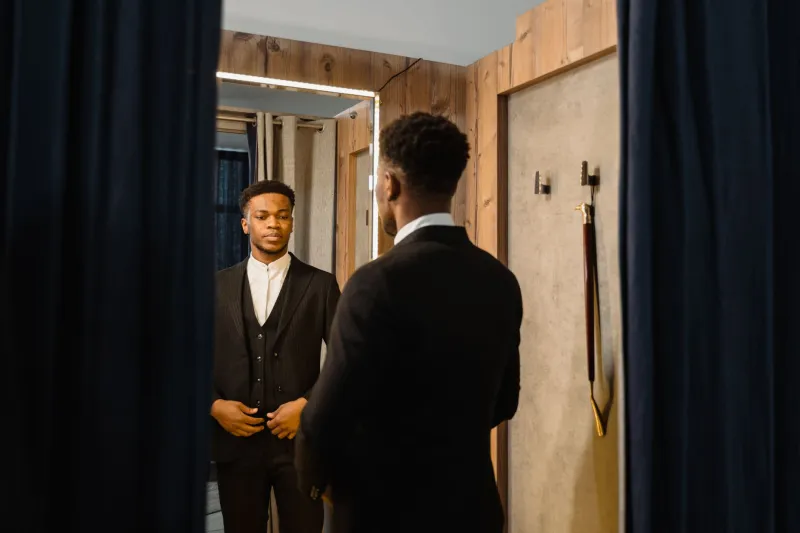
Posure communicates more about a man's internal state than almost any other physical attribute. Rounded shoulders, a dropped chin, or a tendency to lean against walls and furniture all project the same quiet message: uncertainty. Conversely, a gentleman who stands with his spine elongated, his shoulders settled naturally back, and his chin parallel to the floor communicates something far more compelling — ease.
The distinction worth drawing here is between confidence and performance. Puffing out one's chest or adopting an exaggerated military bearing reads as compensatory rather than assured. True postural confidence is relaxed. It says, without a syllable, that this man is comfortable in his own body and, by extension, comfortable in the company of others. That quality — unhurried ease — is precisely what a companion finds reassuring at the outset of an engagement.
Practical note: if you have spent the day hunched over a laptop or behind a steering wheel, take five minutes before your arrival to roll your shoulders, breathe deliberately, and reset your physical bearing. The body holds the day's tension longer than the mind realizes.
The Eyes: Where Respect and Interest Converge
Eye contact is one of the most nuanced instruments in a gentleman's nonverbal repertoire. Too little, and he appears evasive or disinterested. Too much, held too rigidly, tips into intensity that can feel unsettling. The calibration that earns genuine warmth from a companion sits comfortably in between — present, warm, and attentive without being fixed.
When making an initial greeting, meet a companion's gaze naturally and hold it for the duration of the introduction. Then, as conversation or movement begins, allow your eyes to move as they would in any relaxed social interaction. The message this sends is one of genuine interest rather than appraisal. There is a meaningful difference between looking at someone and looking toward them, and a discerning companion will feel that difference immediately.
Avoid scanning the room, checking your phone, or allowing your gaze to drift during those first critical moments. Divided attention reads as either discomfort or disrespect, and neither serves the tone you are working to establish.
Pacing: The Rhythm of a Man at Ease
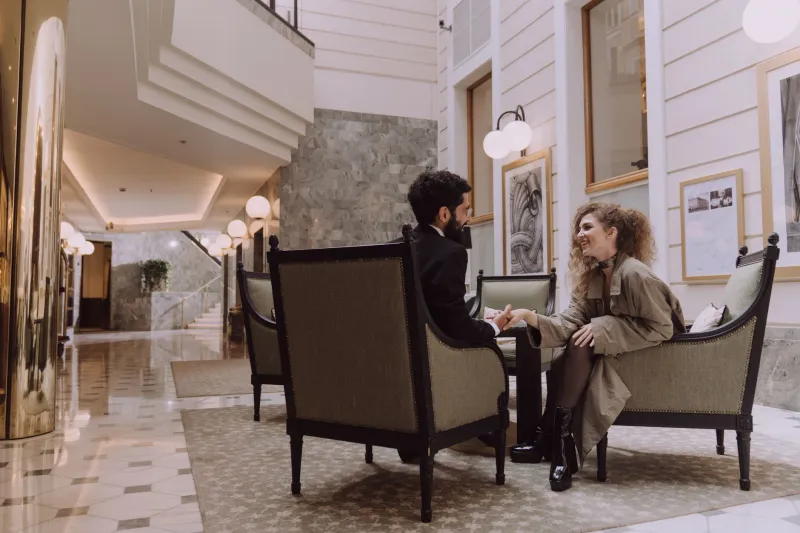
How a man moves through space — his pace, his transitions, the way he navigates a lobby or approaches a table — tells its own story. Hurried movement signals anxiety. Exaggerated slowness can read as theatrical. What communicates most effectively is a measured, unhurried rhythm that suggests a man who is exactly where he intended to be, arriving precisely when he meant to.
This extends to smaller gestures as well. The way a gentleman removes his coat, sets down his belongings, or draws out a chair all carry weight. Abrupt, jerky movements suggest internal agitation. Smooth, deliberate actions project composure. The goal is not to appear choreographed — it is simply to move as a man who has nowhere more important to be and nothing more pressing on his mind.
If you find yourself arriving flustered — delayed by traffic, disrupted by work — allow yourself a transitional moment before making contact. A brief pause in the lobby, a slow breath in the elevator, a moment to gather yourself before knocking. Arriving composed is always worth the extra sixty seconds it requires.
Grooming: The Details That Speak for Themselves
No discussion of first impressions is complete without addressing the physical presentation a gentleman brings to the encounter. Grooming is not about vanity. It is about demonstrating that you value the occasion and respect the person you are meeting.
The standard here is clean, considered, and appropriate to the setting. Freshly pressed clothing in a style suited to the venue. Shoes that have been attended to. Hair that has been styled rather than simply dried. Nails that are trimmed and clean. A fragrance — if worn at all — applied with restraint, since an overpowering scent is among the most common and least forgivable grooming missteps.
These details require no extraordinary effort. They require only the decision to make them. And that decision, visible in every pressed seam and every considered choice, communicates to a companion that this gentleman regards the evening as worthy of his full preparation.
The Quiet Confidence That Precedes Everything
Underlying all of the above — posture, gaze, pace, and grooming — is a single quality that cannot be faked but can absolutely be cultivated: quiet confidence. Not the loud self-assurance of a man who needs to be seen, but the settled certainty of a man who is simply, genuinely present.
Quiet confidence sounds like nothing. It looks like a man who smiles without performing, who listens without interrupting, who occupies his space without apologizing for it. It is the product of preparation, self-awareness, and the deliberate decision to bring one's best self to the encounter rather than whatever the day happened to leave behind.
For the gentleman who understands that a companionship experience is, at its finest, a mutual exchange of quality time and genuine engagement, this preparation is not optional. It is the first act of respect — offered before a word is spoken, received before a word is heard.
Arriving as the Man You Mean to Be
The moment of arrival is not the beginning of the evening. It is the culmination of everything you brought to it before you walked through the door. The man who has attended to his posture, his gaze, his pace, and his presentation has already communicated something essential: that he takes this encounter seriously, and that the companion he is meeting is worth that seriousness.
In the world of refined companionship, where discretion and mutual respect form the foundation of every meaningful connection, that silent statement carries extraordinary weight. Make it count.